As sustainability becomes mainstream, BioPak calls for proof over promises and outlines how transparency and circular design can drive real change.
Coined in the 1980s by environmentalist Jay Westerveld, “greenwashing” used to describe a hotel policy encouraging guests to reuse towels with the underlying motivation to save on costs by appealing to guests’ environmental sensibilities.
Fast forward to 2025, and the term has become part of everyday language.
Today, greenwashing has opened the door to an array of confusing claims which make it nearly impossible to assess sustainability credentials – and help customers make the best choices. Terms such as “sustainable”, “eco-friendly”, and “ethical” are now common examples.
Rather than being a business imperative, Richard Fine, Co-Founder of BioPak, says there’s a concern sustainability has become a thematic trend and marketing tool, rather than one focused on genuine progress.
“Some companies wouldn’t try to appear green if people didn’t care about sustainability,” he says.
“But the problem is that a lot of the claims are vague or misleading without any real scientific backing.”
This confusion is especially common in packaging. Labels may claim recyclability, but most food packaging is contaminated with residue, making it unsuitable for that purpose. For small cafés, the risk may be reputational rather than legal. When customers who discover a brand’s claims don’t add up, this can threaten brand trust.
“And for larger brands, the stakes are higher, with the potential of fines or enforcement from the Australian Competition and Consumer Commission (ACCC),” says Richard.
Ultimately, greenwashing slows the transition to genuine sustainability.
With a broader picture in mind, Richard says that BioPak’s vision – grounded in honesty, integrity, authenticity and transparency – supports businesses to serve food conveniently while driving positive environmental and social impact.
“We have a simple but ambitious vision to eliminate single-use plastic packaging and replace it with sustainable alternatives that are better for people and the planet,” he says.

Richard says sustainability was far from mainstream when the company was founded in 2006.
Learning from the past to develop future-based solutions, the company today aims to prove that convenience and environmental care can coexist, creating products that enable circular economies rather than contribute to waste.
Why verified claims matter
Foodservice brands and cafés can still earn consumer trust and strengthen their reputation without risking accusations of greenwashing.
Head of sustainability Lea Maguero, who has been with BioPak for seven years, highlights how the company offers solutions through its verified products across cups, containers, cutlery and more.
“For our products that are compostable, we ensure they are certified to Australian or European standards,” she says.
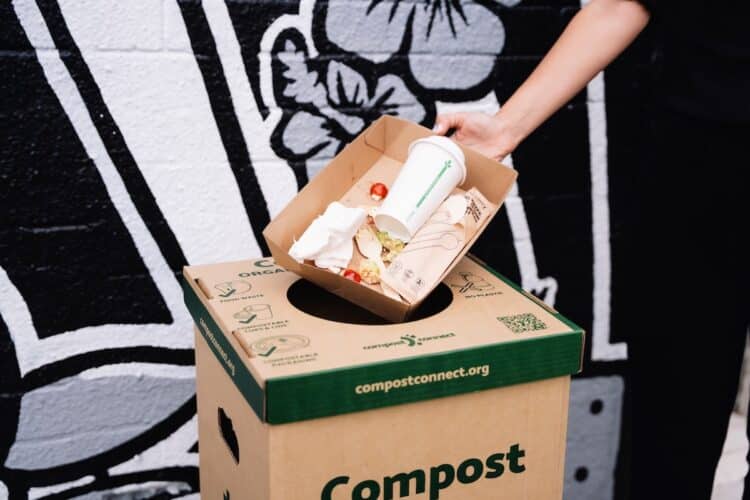
BioPak offers products that are either recyclable, home compostable (AS5810) or industrially compostable (AS4736) to Australian Standards.
Among its portfolio of takeaway coffee cups, lids, bowls and containers, it also provides reusable options like Huskee Cups which are crafted from materials like waste coffee husk and repurposed post-consumer plastic and steel.
Through independently audited and verified third-party credentials by trusted organisations such as the Forest Stewardship Council (FSC), BioPak ensures every environmental claim it makes is verifiable. Products that are labelled compostable or recyclable are tested and certified accordingly. BioPak’s B Corp certification further confirms its commitment to ethical and transparent business practices.
“Transparency is key,” Lea says. “We want to be able to communicate clearly about the materials used for our products, the certifications we have, and the end-of-life options.” Each new item is evaluated against strict environmental and social benchmarks by the company’s sustainability team before it enters the market, part of its broader commitment to ensuring compliance for the foodservice and coffee industry.
“With a team dedicated to sustainability, we can show that our claims are accurate, science-based, and compliant with the evolving regulations,” she says.
Equally important is education. Through clear labelling, customer resources, and events such as trade shows, BioPak helps businesses and consumers understand their environmental impact and how to dispose of products correctly.
Guiding through simplification
As the industry grows more complex, many café owners and foodservice operators struggle to keep up with changing packaging regulations.
Richard notes that what is considered sustainable in one state may not be in another. South Australia, for example, has extensive composting infrastructure, while other states rely more on recycling systems.
“Each state and territory seems to have slightly different requirements, and it can be confusing,” he says. “Our goal is to ensure our products and material choices align with available end-of-life recovery and recycling solutions across different regions.”
BioPak provides tailored guidance to help customers make informed choices based on their local waste facilities. This localised approach recognises that sustainability is not one-size-fits-all and depends on both material design and the systems that handle it after use.

The company also collaborates with governments and industry bodies, including the Australasian Bioplastics Association and the Australian Packaging Covenant Organisation, to inform policy and support a unified approach to circular economy goals.
“Sustainability isn’t just about what something is made from, but what happens next,” adds Richard.
Ultimately, BioPak wants to simplify pain points through streamlined solutions. Lea says that sustainability should be simple and credible, not confusing or performative.
“Education and clarity are essential if we want people to make the right choices,” she says.
Circular design
While retaining customer trust through verified products helps businesses in the short term, Richard sees a longer-term goal for the industry.
“Part of the company’s long-term project is focused on uniting the foodservice industry around a shared vision where packaging isn’t seen as waste,” he says. “It’s part of a circular solution, one that contributes to the health of people and the planet.”
Richard says that every material leaves behind a footprint. Even renewable materials like paper or bioplastics have impact through energy use, water consumption, and transportation. For BioPak, sustainability means reducing that impact across the entire lifecycle from raw material sourcing to end-of-life processing. Therefore, sourcing the right material with a lower footprint that is also regenerative as part of a circular solution is encouraged.
“The ideal product is one that fits in with the local waste and recovery systems,” he says.
While compostables remain central to its range, the company also works to ensure recyclability where composting access is limited.
Compostable packaging, when processed with food scraps, can return valuable nutrients to the soil. Even where composting isn’t available, renewable, bio-based materials lessen dependence on fossil fuels and can reduce production emissions.
“Materials matter, they shape our environmental impact, but so do the systems that recover them. Building both is key to a truly circular future,” he says.
Giving back to the environment
Looking to the future, BioPak’s Science Based Targets initiative (SBTi) commitments aim to achieve net-zero emissions by 2050.
“We want to transition to renewable energy wherever possible,” says Richard. “We’re closely working with our suppliers to embed sustainability in every business decision.”
BioPak’s broader vision hopes to unite the foodservice industry around a shared goal where packaging is no longer seen as waste but as part of a regenerative system. To achieve this, the company continues to invest in research, education, and collaboration. Its strong environmental and social values are reflected in everything from product design to customer education and public advocacy.
“We set high-level goals to motivate us to make a change in the world,” Richard says. “We want to add value to the environment rather than just extract from it.”
Its mission remains as relevant now as it was in 2006: to create packaging that supports the planet, not just convenience. In an era of marketing buzzwords and greenwashing, BioPak’s approach reminds the industry that genuine sustainability is built on proof, not promises.
“We live our values,” says Lea. “What we create and communicate reflects the change we want to see in the world.”
For more information, visit biopak.com/au/
This article appears in the December 2025 edition of BeanScene. Subscribe HERE.