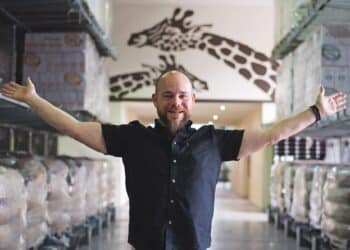
BioPak discusses the validity of compostable packaging in the market and the importance of correct certification labels.
According to Compost Connect board member and BioPak CEO Gary Smith, one of the benefits of using compostable packaging materials is that they are designed with the circular economy in mind.
“Companies are now looking towards plastic-free packaging solutions due to growing concerns for waste in the environment. While traditional paper cups are lined with a Polyethylene plastic lining, BioPak applies a plant-based renewable lining to its cups, which provides the same barrier so liquid doesn’t leak through,” says Gary.
“This means the compostable packaging is able to live beyond the waste part of the cycle, re-entering the resource stream as nutrient-rich compost, improving our soil and allowing healthy plants to absorb more carbon from the atmosphere as they grow.”
Gary says aqueous, or water-based barrier-coated cups are also becoming popular.
“The water-based barrier coating is a form of barrier that is applied through a very thin water-based dispersion onto paperboard,” he says.
“However, after commissioning research at Newcastle University’s advanced sustainability research department, we do believe a small portion of the raw material is plastic. While it’s still a water-based solution and currently deemed as industrially and home compostable, we are working with the research organisation to fully understand the environmental risks of this material from a life-cycle perspective.”
Gary says increased demands for plastic-free solutions and confusing regulatory guidelines can create a market of unsubstantiated claims.
“While people are asking for plastic-free, we won’t advertise an aqueous cup as plastic-free because it’s not. We aren’t in the business of greenwashing and misleading the public, we only make factual claims,” he says.
A compostable product is one that, when properly disposed of, will disintegrate into natural elements in a compost environment, leaving behind no toxicity or residue in the soil.
“But making this claim requires factual evidence in the form of certifications. It’s not uncommon to see companies choose to label their products as biodegradable instead, which unfortunately contributes to confusion around disposal and can result in incorrect disposal or littering,” says Gary.
To ensure packaging is certified compostable by the Australasian Bioplastics Association (ABA), Gary says café customers can visit the ABA website and look up exactly which businesses are compost certified.
“BioPak products are certified compostable. This means our packaging will biodegrade completely when disposed of according to the correct composting conditions. For industrially compostable materials, such as compostable plastics, the biodegradation time that is within 12 weeks in a commercial composting facility. For home compostable materials, such as fibre-based products, that can be 180 days, in the colder conditions typically found in home compost bins,” Gary says.
He adds that consumers can also do their part to reduce waste.

“Check to see if your council accepts compostable packaging in your green waste bin or find a café participating in the Compost Connect BioPak compost collection service. Simply dispose of the cup and lid into the bin where it will make its way to an industrial compost facility and be converted into compost,” says Gary.
While many believe composting to be a costly and time-consuming endeavour, Gary stresses it’s a simple process.
“The compost industry is well established, so we are not starting from scratch. Opting for compostable packaging doesn’t require setting up new and expensive waste streams or adding more trucks on the road. There is strong evidence using compostable packaging increases food waste collections, and less food waste in our landfill will reduce the impact of greenhouse gases that are released when organic materials decay in landfill conditions,” Gary says.
“By choosing certified compostable products, you get the guarantee your waste will be swiftly turned into nutrient-rich compost and support local industry. [You’ll] avoid sending tonnes of plastic to landfill each year, limit the amount of plastic pollution in our environment, and help reduce greenhouse gas emissions to combat global warming.”
As a responsible business, BioPak is dedicated to showing the café industry that there is a more sustainable option available.
“Any food that remains in conventional plastic or fibre-based food packaging products contaminates the recycling stream, making it an impractical solution for foodservice packaging,” says Gary. “With composting, this isn’t an issue. Both food and compostable packaging products can be put in the same bin, no separation or sorting required,” Gary says.
“Whether it be for convenience, to reduce greenhouse gas emissions, to improve soil health or to fight plastic pollution, compostable packaging is the future of the food service industry.”
For years, BioPak has worked to educate businesses and the general public on the unsustainable characteristics of plastic and how it has become an unwanted geographic feature of our collective landscape.
“BioPak is more than just about compostable packaging. We envision a future in which materials are made from sustainably sourced, rapidly renewable biological resources and recycled back to the soil,” Gary says.
“As the world focuses on developing a more sustainable circular economy and governments align policy to address plastic pollution, we must remain vigilant and ensure that new materials do not have unintended environmental consequences.”
For more information, visit biopak.com.au and compostconnect.org
This article appears in the August 2022 edition of BeanScene. Subscribe HERE.