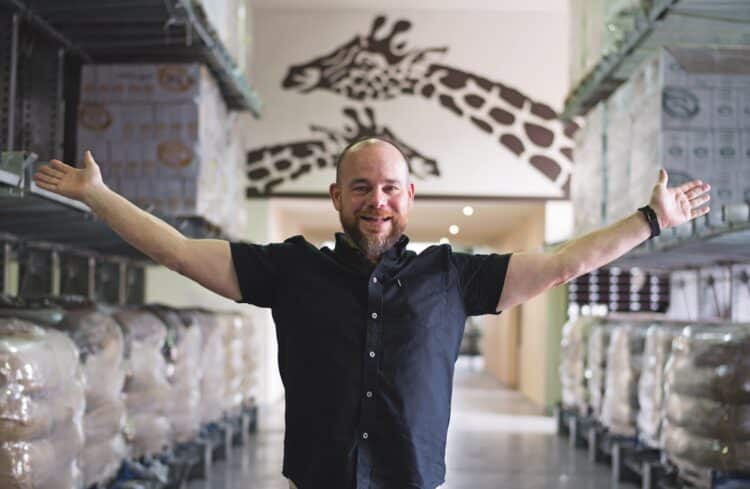
From a roastery in the backstreets of Southport, Queensland to a specialty coffee chain with a national presence, Kenton Campbell discusses how Zarraffa’s Coffee is primed to take over the Australian convenience coffee niche.
The 2032 Brisbane Olympics may seem a world away for some, but for Zarraffa’s Coffee Founder and Managing Director Kenton Campbell, it’s a milestone of Australian sport he has long earmarked to coincide with a milestone of his own.
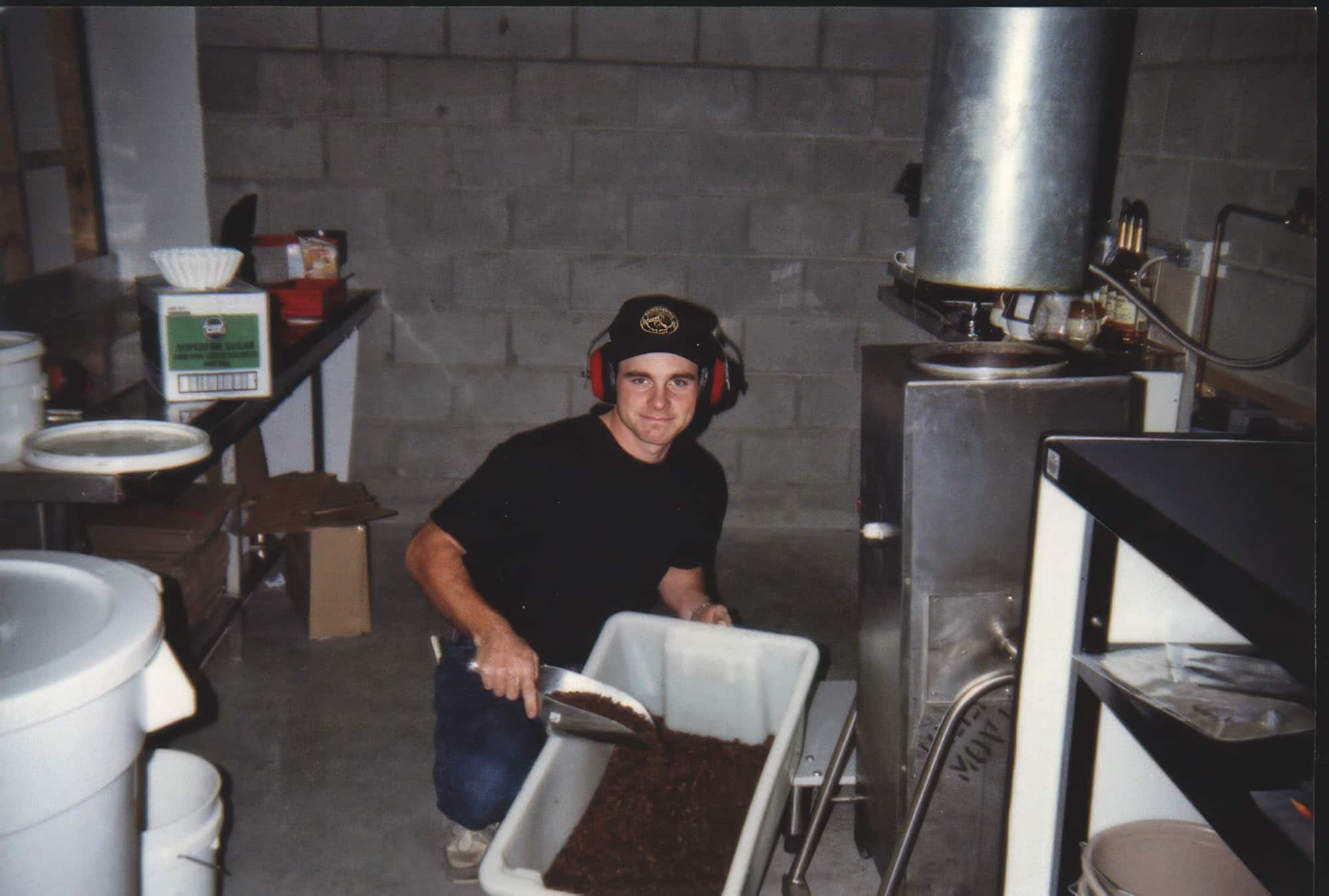
Kenton and Rachel Campbell started Zarraffa’s as a roasting house in Southport in 1996, where customers would sit on hessian bags of beans while enjoying a cup of coffee. It has since evolved into a franchise model with more than 90 locations across Australia. By the time the Olympics roll around, Kenton hopes that number will be more than double.
“It was 10 years ago when we came up with the Brisbane Olympics target as a KPI, and that’s because it’s a huge event that will be in our backyard,” Kenton tells BeanScene.
“We want to be iconic in Australia, that’s our ‘gold medal’. The strategy was to look for a number that was achievable, but a big target at first. We’re still looking at opening about 15 stores a year to reach it, but that 200 puts us out there as being able to take that mantle.
“There aren’t many brands that make it to that size unless they’re a big US chain coming here. To be an Australian-built brand to have done it would be more than a token, it would be something to be celebrated.”
Scaling smart
While Zarraffa’s itself was born in Queensland, Kenton arrived in the Sunshine State in 1995 from the United States (US) at the invitation of a coffee company to become a consultant. This was after engaging with representatives of the business from his coffee cart in Seattle.
After an inauspicious start to his time in Australia – he was in a car accident on his very first day – he opened the first Zarraffa’s in 1996. He and Rachel still operate a singular corporate store within the brand’s many franchises, but it hasn’t all been plain sailing.
“We had as many as 20 of our own stores at one point, especially during the consolidation of our stores in the shopping centres where we helped franchisees into stores or would buy them out and close them up when the lease term finished. We did that because that’s what needed to be done,” he says.
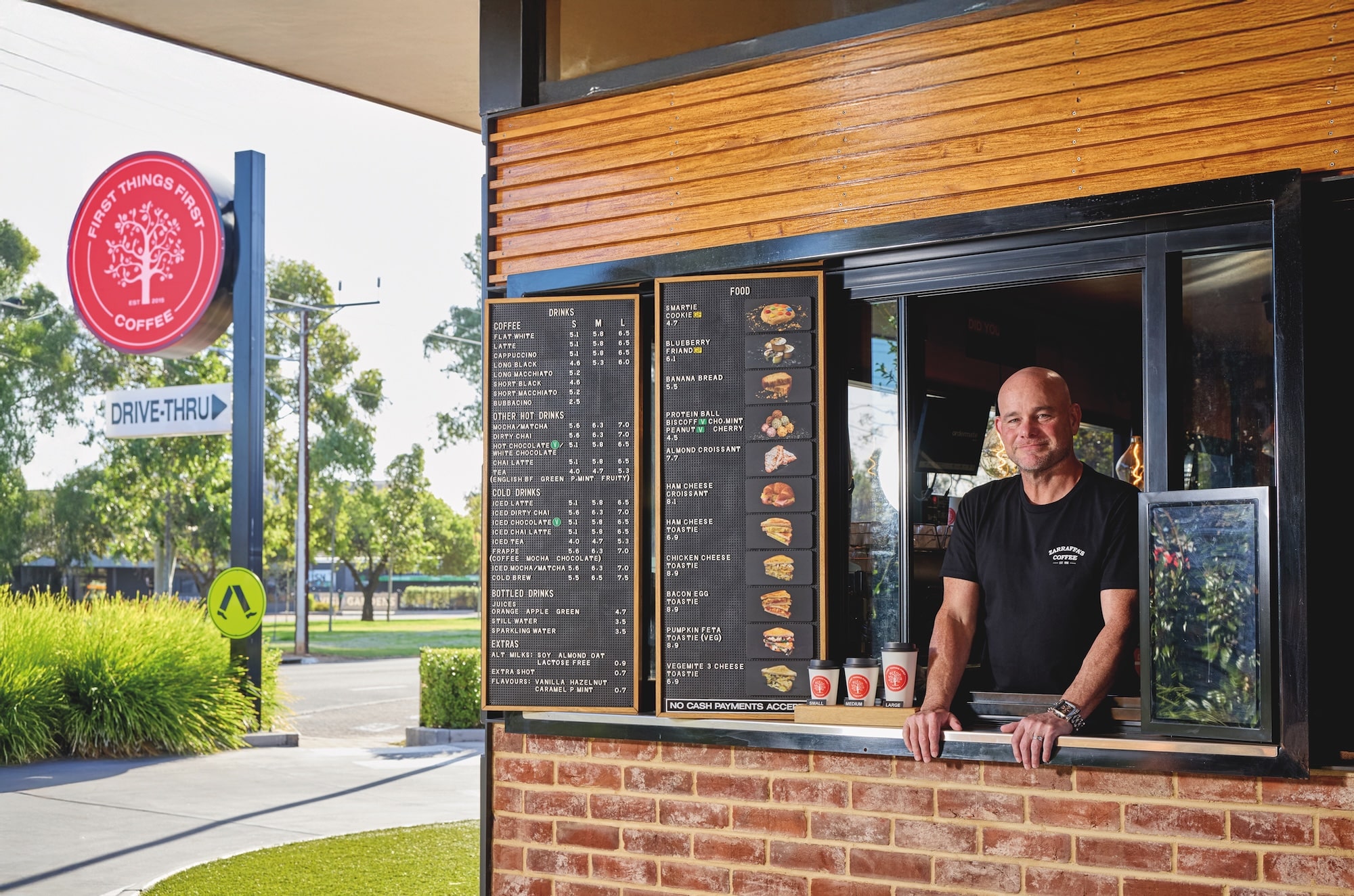
As a brand, Zarraffa’s has been expanding away from its Queensland base in recent years – expedited by the acquisition of First Things First Coffee in South Australia earlier this year.
Within the space of a week in October 2025 it opened its first stores in Adelaide (Munno Para) and Melbourne (Packenham South) and is continuing to consolidate a nationwide presence.
Both these new sites have been opened by existing franchisees, and that model of enabling known quantities from within the business to stretch themselves with their own locations, Kenton says, has been critical for not only the progression of Zarraffa’s, but its survival.
“More than two dozen of our stores are owned by previous store managers and we help them expand into franchising with our manager program,” he says.
“We financially help our managers that have been running a store for three to five years, and rather than lose them to the brand we’re losing them into the brand by helping them set up their own stores.
“What that means is they know what’s going on and how we operate, and utilising a knowledge pool like that makes so much sense. It’s fundamental to our success.”
With 2026 marking a full 30 years of operation for Zarraffa’s, Kenton says this desire to keep everything in-house has now, in fact, extended to keeping it in-family.
“We’ve now got second and third generation franchisees, the kids are taking over and they’re hungry for it. We remember when they were little and running around the store, but now they’re pumped up and running it,” says Kenton.
“Our current franchisees are using it as a succession plan for themselves, and it’s working. Any new franchisees must be vetted – they usually come in and do a two week trial and after that there’s about three months of training in a franchise partner store, and they can say if they don’t think they’re a fit for the business.
“If you’ve got a franchisee that’s recalcitrant or not wanting to follow a system, it’s better to end it there. All our franchise partners are congruent, they all care, and they’re all excited for the brand and where it’s going.”
The new Adelaide site, although part of the First Things First acquisition, is the perfect example of Kenton’s desired franchisee and family succession. The location is operated by Bill and Claire Zavos, who have held locations in Queensland but since returned home to Adelaide.
Alongside them are their sons, Sam and Dillon.
“We’re blessed to have options and opportunities now where we probably won’t have to look outside the brand for franchisees in the coming years, that would be my goal,” says Kenton.
“We’re very much looking at New Zealand to be part of our portfolio even though it’s international. It’s closer to a lot of Australia than Perth is. The market has nothing but growth in it.
“In the next few years, we’ll be in the Northern Territory – Darwin is begging for it. I just have to find a franchise partner that wants to go up with us.”

The convenience kings
The scope of Australia’s café and coffee scene is incredibly broad. From espresso bars to Italian cafés, service stations and after dark restaurants, it’s a packed and hyper competitive market.
Kenton believes saying you work in coffee is comparable to saying you’re a lawyer – it gives people an idea of what you do, but there’s a huge spectrum of specialties you could actually be working in.
With a significant personal background in coffee and hospitality, both in the US and Australia, Kenton has built Zarraffa’s on the promise of high-quality products and service, and has doubled down on the convenience factor.
“We know what is best for our brand in what is a very big industry. We fit a niche, and we fit it well,” he says. “We’re not going to be challenged easily by anyone who comes along. We’re not one of the really big guys, but those big international players don’t scare us.
“It’s all about the offer, but I think the drive thru for our industry is fundamental for convenience.
“We’ve got people who come through daily, twice a day, or more, and you want to make it as easy as possible for them to do that. It’s the ultimate convenience for a customer.”
While drive thru coffee is extraordinarily popular in high density regions of the US, it’s a concept that is still finding its feet in Australia. Competing brands like Soul Origin are getting involved and has recently launched its first drive thru in Melbourne, along with countless small operators and independent businesses making moves in the space.
Then, of course, there are the major global players like McDonald’s and Hungry Jack’s to compete with.
Kenton believes Australia’s drive thru coffee market isn’t necessarily playing catch-up to the US but it, in fact, exceeds it in key service areas.
“The drive thru model is probably what saved the brand, to be quite honest. If we were in centres alone, we probably would have sold up a long time ago. The smartest thing we ever did was getting into drive thrus in 2009, it’s what set the brand up for many years of expansion,” says Kenton.
“Are we behind the States? No, I think we’re actually on the forefront of convenience when it comes to quality of service and product. I think Australia and New Zealand are world leaders in this space and I haven’t seen or heard anything different.”
More than branding
When looking at a Zarraffa’s cup, storefront, or uniform, it’s hard not to be drawn to the gold and green logo featuring the long necks of a pair of giraffes stretching across the centre.
“When I was looking at what the brand could be, I would write everything I needed to have a specialty coffee company in a little Filofax Rachel had given me,” says Kenton.
“The first thing on it was brand, and I had monkeys, a rhino, and a giraffe, which on its own didn’t make sense. I went to a library and saw in a book that ‘Zarafa’ was Arabic for giraffe, and that was the start.
“It sounds cultural, it sounds significant, and it’s different and identifiable.”
That alignment and affiliation with wildlife extends beyond marketing though, it’s weaved into Kenton’s ethos as an entrepreneur and feeds into how the brand operates.
Kenton – and Zarraffa’s – have partnered with Australia Zoo and Wildlife Warriors pledging vital funds for global conservation efforts. A dream partnership alignment since he met the late Steve Irwin and his father, Bob, in the early 2000s.
In addition to supporting Australia Zoo’s conservation efforts, Kenton and Zarraffa’s support coffee cooperatives around the world, whether that be through consistent sourcing of beans, or limited-edition single origins like its recent Ethiopian Sidamo release.
“We’ve supported the Meru Coffee Cooperative, Ntongoro, in Kenya for more than a decade, and Rachel and I are preparing to go to Kenya to look for another cooperative to support,” he says.
“It’s a unique opportunity to have a brand that can do the very thing people are looking for, and gives hope that these iconic animals all around the world, including here in Australia, can have the ability to live amongst us if we just let them.
“It’s cool we have an opportunity as a brand to do this and it’s real, it’s not fake – it’s right there in front of us. The partnership with Australia Zoo is very important to us and they do an incredible job with what they do, so we’re very aligned. Now as a brand we’re not just there to make money, we’re there to make a difference in the long run.”

Truly Australasian
It’s clear Zarraffa’s has come a long way from Kenton’s dream almost 30 years ago. What started out with a $9000 personal loan back in 1996 has turned into one of the largest Australian-owned and operated specialty coffee businesses in the country.
“It’s been a rollercoaster, but that’s business. The advice I give people is when having your own business there is going to be sacrifice, and if you’re not willing to take that on, stick to working for someone else and do your part there, you can go home and rest easy and have your weekends,” says Kenton.
“It started with trying to get the business to a point where I could replace $300 a week so I could pay myself out of the business, meaning I could work on it, rather than in it, and not have to do jobs like payroll in the evenings.
“It’s taken a lot of time and sacrifice to get where we are today, and most of that has been worth it looking back at how incredible the business has become.”
With Queensland all but conquered, and that 200-location goal still within realistic reach, Kenton hopes Zarraffa’s can keep carving that same niche in its new markets.
“I would say of those about 100 stores [to get to 200], 90 will be outside Queensland,” he says. A significant amount of those, the way it’s looking right now, will be in Victoria, South Australia, and New South Wales, and we have another push coming in Western Australia.
“We’ve just done a deal where late next year we’re looking to develop in the ACT, and when I was in Tasmania recently I was driving from Launceston to Hobart and sending all sorts of messages to leasing agents. We’re looking at being truly national in the next few years, as well as potentially in New Zealand.
“Because we’ve got a lot of different models now, we can be versatile so we’re ready to take opportunities whether they come up in centres, in kiosks, or drive thrus, reverse drive thrus, or elsewhere.”
Now, with the toes dipped into some of those new markets, Kenton says everyone involved at Zarraffa’s is ready to build the brand into what he hopes will be one of the largest and most iconic in Australia.
“In Melbourne people are pronouncing ‘Zarraffa’s’ incorrectly. A lot of people are calling it ‘Zaffarelli’s’, but that’s good because they don’t know us yet. It’s awesome, and it’s an opportunity. Once they all know it, you know you’ve done a good job,” he says.
“The coolest part is, yes, Zarraffa’s is something we created, but it’s its own entity now. We’re on this ride with a bunch of other people, but now we’re the oldies in the back, the boomers looking at these young people coming in – and they’re more excited than I ever remember us being.
“That’s the future of our brand.”
This article appears in the December 2025 edition of BeanScene. Subscribe HERE.