• About
  • Subscribe
  • Advertise
  • Contact
  • MICE
Thursday, December 11, 2025
Newsletter
SUBSCRIBE
  • Coffee News
  • Features
    • Industry issues
    • Interviews
    • Knowledge leader
  • Coffee community
    • Competitions
    • Events
    • Get to know
    • People
    • Sustainability
  • Industry insights
    • Café insights
    • Green bean
    • Manufacturers
    • Milk and alt milks
    • Roasters
  • Skills & education
    • Business advice
    • How to
    • Latte art
    • Recipes
    • Research
    • Tutorials
  • Equipment & tech
    • Automation
    • Coffee machines
    • Grinders
    • Milk steaming
    • Roasting technology
    • Technology
  • Café scene
    • Australian Capital Territory
    • New South Wales
    • Northern Territory
    • Queensland
    • South Australia
    • Tasmania
    • Victoria
    • Western Australia
    • New Zealand
No Results
View All Results
  • Coffee News
  • Features
    • Industry issues
    • Interviews
    • Knowledge leader
  • Coffee community
    • Competitions
    • Events
    • Get to know
    • People
    • Sustainability
  • Industry insights
    • Café insights
    • Green bean
    • Manufacturers
    • Milk and alt milks
    • Roasters
  • Skills & education
    • Business advice
    • How to
    • Latte art
    • Recipes
    • Research
    • Tutorials
  • Equipment & tech
    • Automation
    • Coffee machines
    • Grinders
    • Milk steaming
    • Roasting technology
    • Technology
  • Café scene
    • Australian Capital Territory
    • New South Wales
    • Northern Territory
    • Queensland
    • South Australia
    • Tasmania
    • Victoria
    • Western Australia
    • New Zealand
No Results
View All Results
Home How To

Back to the latte art basics

by Ethan Miller
August 16, 2021
in How To
Reading Time: 4 mins read
A A
latte art basics
Share on FacebookShare on Twitter

Mocopan Coffee’s Babin Gurung on how to tackle the core latte art basics and techniques that, once achieved, open up a huge window of opportunity to let your imagination run wild.

When I see latte art appear on my ordered coffee, it shows that the barista has put love and care into preparing the drink. Although the focus should always be on flavour, making it visually appealing is also an important part of serving coffee. 

There are infinite number of latte art designs that you can pour, but in order to get confident and consistent, it’s necessary to master a few techniques.

Good latte art always begins with well textured milk. Portioning milk correctly is important for consistency and control.

Refer to my BeanScene December 2019 article on How to texture milk and perform the perfect pour to learn more.

I find wide-mouth cups or glasses are easier to pour into.

Once you achieve a latte texture of one centimetre of froth, the fun really begins. 
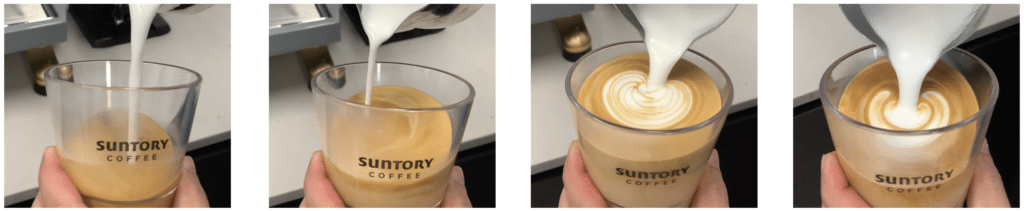
latte art basics
Left to right: piercing, blending, placing, and pushing.

Piercing: This refers to pouring milk from 10 to 15 cm height from the surface of your espresso at a slow and steady pace. This will ensure the milk sinks to the bottom without disrupting the crema. You not only retain maximum colour but flavour in your espresso with this technique. 

Blending: As you pour your milk, swirl your jug around the cup to soften and even out the crema, giving you a uniform backdrop to pour your latte art onto. This can also be achieved by moving the jug from side to side. If doing this on a cappuccino, a fine layer or chocolate powder can be added before blending. 

Placing: Once the cup is half to three quarters full, lower the jug and place the spout in the centre of the cup and pour fast. This nose-dive of the jug will ensure the froth comes out and forms a round shape (often known as Monk’s Head) in the centre of the cup. Make sure the spout of the jug is straight and swivel if the froth doesn’t come out.

Pushing: During placing, you can move your jug forward to push the monk’s head towards the back of the cup. A slight tilt to the cup and nose-diving the jug further will help with pushing. This technique is useful when pouring rosetta or tulip.

latte art basics
Left to right: stacking, swaying, dragging, and cut through.

Stacking: After creating the first Monk’s Head, use the pushing technique to add a second one, keeping a gap in between. This second Monk’s Head will push the first one creating a curve. Repeat multiple times to create a stack which can be used for a tulip, stacked love heart, inversion swan, and a few other designs.

Swaying: Swivel the jug from side to side in a constant motion while keeping the spout close to the surface. For this technique, move your wrist and not your arm. Keeping the spout in the centre while swaying will give you a wavy Monk’s Head while pulling back gives you a rosetta. Swaying requires a lot of practice which can be done just using an empty jug. 

Dragging: This technique is used for drawing lines on a design. The best example of dragging is the neck on a swan. This is usually done towards the end of a pour as the remaining froth makes it easier to drag. You will need to pour low and slow continuously to get the best result.

Cut through: This technique is used for finishing latte art where you lift the jug slowly and swipe the jug in an upwards motion. This will cut through the design in a straight line giving you the final shape. If the jug isn’t high enough, it can create a dragging effect. 

latte art basics


BeanScene is now on LinkedIn! Follow HERE to stay up to date on all things coffee.

Tags: coffee arthow tolatte artMilkpour

Related Posts

The Australian matcha market is expected to grow to $82 million by 2030.

A guide to the perfect matcha

by Daniel Woods
November 12, 2025

Matcha is giving coffee a run for its money in the popularity stakes, but what actually is the vibrant green...

Images: Prime Creative Media.

Monkey King latte art by Victor Vu

by Daniel Woods
July 29, 2025

Three-time Australian Latte Art Champion Victor Vu shares the steps to recreate the popular monkey king design. This design was...

Images: Prime Creative Media.

Baby owl latte art by Victor Vu

by Staff Writer
May 12, 2025

Australian Latte Art Champion Victor Vu shares his baby owl design, part of the family of jungle-inspired pours he presented...

Join our newsletter

View our privacy policy, collection notice and terms and conditions to understand how we use your personal information.

BeanScene Magazine is committed to promoting, enhancing and growing the coffee industry in Australia as it’s coffee news has captured the attention of coffee roasters, bean and machine importers, café owners, café chain owners and executives, and many of the auxiliary products and services that support the coffee industry in Australia and around the globe.

Subscribe to our newsletter

View our privacy policy, collection notice and terms and conditions to understand how we use your personal information.

About Beanscene

  • About
  • Contact
  • Advertise
  • Subscribe
  • Latest magazine
  • Terms & conditions
  • Privacy collection notice
  • Privacy policy

Popular Topics

  • Coffee news
  • Features
  • Coffee community
  • Industry insights
  • Skills & education
  • Equipment & tech
  • Cafe Scene

© 2025 All Rights Reserved. All content published on this site is the property of Prime Creative Media. Unauthorised reproduction is prohibited

No Results
View All Results
NEWSLETTER
SUBSCRIBE
  • Coffee News
  • Features
    • Industry issues
    • Interviews
    • Knowledge leader
  • Coffee community
    • Competitions
    • Events
    • Get to know
    • People
    • Sustainability
  • Industry insights
    • Café insights
    • Green bean
    • Manufacturers
    • Milk and alt milks
    • Roasters
  • Skills & education
    • Business advice
    • How to
    • Latte art
    • Recipes
    • Research
    • Tutorials
  • Equipment & tech
    • Automation
    • Coffee machines
    • Grinders
    • Milk steaming
    • Roasting technology
    • Technology
  • Café scene
    • Australian Capital Territory
    • New South Wales
    • Northern Territory
    • Queensland
    • South Australia
    • Tasmania
    • Victoria
    • Western Australia
    • New Zealand

© 2025 All Rights Reserved. All content published on this site is the property of Prime Creative Media. Unauthorised reproduction is prohibited